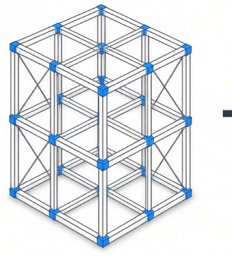
Thermal expansion
Unrestrained. No stress from prevented expansion.
Method
δ = αLΔT. Worked case: steel 12×10⁻⁶, 10 m, 40°C is 4.8 mm.
What to write beside the result
A review can only check this figure if the inputs sit next to it. Write the value, the unit and the assumption the form used. A diameter in millimetres and a diameter in metres are not the same reading. A force in kilonewtons divided as if it were newtons is a thousand-fold error.
The result is the arithmetic on this page. It is not a utilisation, not a selected product, and not a clause from a standard. If the number is going into a shared container, name the page, the date and the inputs. The file-name checker does not read the calculation.
Logic: how this figure is built.
How to read a thermal movement
Movement is αLΔT. Steel at 12×10⁻⁶ per kelvin, 10 m long, with a 40 K rise, moves 4.8 mm. The coefficient is the material you have. Concrete and aluminium are not that 12.
Length is the length free to move. A member fixed at both ends does not become 4.8 mm longer. It builds a force instead. This page is the free movement.
The temperature change is the change in the member, not the air temperature on the day the drawing was issued, unless those are the same.
Use it to see the order of a joint or a sliding support. It is not a stress and not a bridge-bearing selection.
- Related: direct stress
- structural logic
Last checked 3 October 2026. See the common-calculations note and the disclaimer.